Friday, May 20, 2011

New Blog Location

This blog is going to continue at http://foodfordrama.com. Hope to see you there! Ursula

Monday, February 7, 2011

Sofi Oksanen: Purge

PurgeThis very dark novel about Estonian life from the 1930s to the 1990s, especially from the female point of view.

The story pictures two sister, envy that leads to betrayal and the Gulag, failure to communicate that leads to more suffering and ultimate loneliness.

It is interesting to read how the Russian occupation was perceived, and how the communists, both Russian and Estonian, took control of the people.

The connection is then made from the communist oppression machine to the modern day Russian mafia, with many players just changing roles, especially viewing women then and now as disposable. The forced prostitution part is quit graphic,hard to read, it is that painful.

Interesting also the description of Estonian lifestyle in the 1990s: The countryside population is so very poor compared to the Western standard of living, but don't see it that way. Foraging of mushrooms and herbs (for medicinal purposes) is a way of life, a boiled pig ear a nutritious dinner.

Friday, February 4, 2011

Sophie Hannah: The Dead Lie Down

The Dead Lie Down
The book was slow to start, and I was annoyed with that everybody seemed to be so crazy and disfunctional, the police just as much as the people who were talking about murders that apparently didn't even happen.

However, it pulled me in, and I couldn't figure the story (even after glancing over the end), and by the time I managed to read the first half, it actually became interesting and compelling. It helped that after a while, the crazy people became human, as more personal background was revealed.

The story is set in small town Britain, not too far from London. Fascination with art, no, obsession with art, and also with controlling people to the extreme, a lot of damaged personalities, be it through their upbringing or through abuse later in life, make this crime novel interesting.

Thursday, February 3, 2011

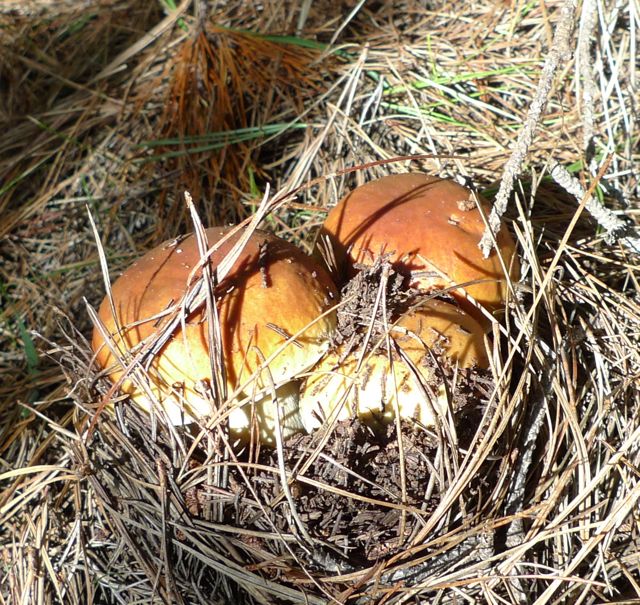
Mushrooms at Point Lobos


Point Lobos, a park close to Carmel, in Northern California (or more like close to the middle) used to be a major whaling and abalone fishing location. Located at the whale migration path, if was ideally situated for killing whales, a sad and brutal operation (just look at the weapons in Point Lobos' whaling museum).

Nowadays, the park with stunning views of the ocean is a major destination for tourists. We were lucky to get wonderful weather in January. Additionally to the picturesc views, many mushrooms were sprouting in the woods. Why do people kick pretty mushrooms when they see them? If you can identify a mushroom, please leave a comment, and I'll annotate!


Pretty, earmushroom like!
Is it a Phaeolus schweinitzii?


The yellow version of the Fly-agaric (Fliegenpilz). http://en.wikipedia.org/wiki/Fly_agaric


Dark cap, white stem, gills


Death cap? I don't think so, there were many parasols in the area.


Another fly agaric.


Very pretty cluster.


And yet another fly agaric.


And finally, a bolite (Steinpilz).


Wednesday, February 2, 2011

Rosenkohl and Butternut Squash

Yes, it's called Brussels sprouts in English, but I find the word Rosenkohl (rose cabbage) much more fitting.

Rosenkohl always has been a treat for me. My mother used to steam it, season it with nutmeg and toss it in butter or bechamel. In America, I learned how to pan fry Rosenkohl with bacon, which adds a whole other set of flavors.

Recently, after picking up our vegetable box, we had dinner at the excellent restaurant Incanto in Noe Valley (San Franciso), where they served Rosenkohl with course mustard, a tasty combination. They even sold the mustard (Boccalone, made in Oakland),  delicious and actually cheaper than the mass produced German version from the German store.  I adapted the recipe, and altered it to my liking:

Ingredients: about 20 Brussels sprouts, 1 strip of bacon, a splash of white whine, a tablespoon of course mustard, pepper.

Clean the sprouts by removing the outer layer. Bring one inch of water in a smallish pot to boil (with a steamer insert, if you have one). Add the largest sprouts, and then every minute the next largest, until you have them all in. Steam with closed lid for about 5-7 min total. The time starts when you put the first sprout into the pot. 

The sprouts are now very close to being cooked. If you prefer them a little more crunchy, reduce the steaming time. At this point, you can just put them into the fridge until you are ready to finish them up later in the day or the next day, which just takes a few more minutes in the pan.

Chop bacon and fry in small frying pan. When the bacon is close to being crispy, add the sprouts, reduce the heat, stir and leave alone for a couple of minutes, until the bottom of the sprouts turns a little bit brown. Stir again to give the top part a slight browning, add pepper and mustard, stir, serve and enjoy!

We also had Butternut squash in our recent vegetable box from Mariquita,  which we enjoyed together with the Rosenkohl and a nice rib-eye steak last night. Microwave squash until it is a little soft. Cut in half, clean out the innerts, and cut in one inch slices (peeling is not necessary). Since the (gas) grill was already going, G. barbecued the squash, after marinating it with thyme, a little mint, olive oil and lime juice. While on the grill, she basted the squash with a honey/lime juice baste, to give it more flavor. This is not necessary on a charcoal grill - plenty of smokey flavor from the coals. Highly recommended if you like Butternut squash!

I have been neglecting my blog for a while. However, I recently added a number of new book reviews to goodreads (see side bar). I might post a summary here later.


Wednesday, July 7, 2010

Smita Jain: Kkrishnaa's Konfessions

Kkrishnaa's Konfessions Kkrishnaa, the protagonist, is a screen-writer for an Indian soap, and observes the inhabitants of a neighboring luxury apartment building with a telescope to find ideas for her soap (she suffers from writers block). The most bizarre things happen over there, but apparently not bizzare enough, because Kkrishnaa decides to stirr the pot and add a little pseudo-blackmail. After she witnessed a murder, her life is in danger. Incidentally, most people who live in the building are connected to the murdered woman. The police is very forthcoming to share their findings with K. and eventually, she solves the murder. Kkrishnaa is a witty, ruthless, not very likable but amusing person mostly interested in advancing her career, and surrounded by career-related intrigue. Plenty of examples of her screen-writing are given in the book, with insight into the values these soaps want to convey and the way Indian TV is written ("faints, repeat three times from different angles in slow motion"...). Interesting and fast paced, quite over the top exaggerations (I hope) of modern Indian life.

According to the author, this is a chick-lit. First time I heart this term, I guess I am out of touch (or maybe, not a native English speaker). 

Friday, July 2, 2010

SFOpera: Gounod's Faust

The conclusion (for us) of the 2009/2010 opera season at the San Francisco Opera was yesterday's Faust (Gounod). It started in a high-note: The lecture (by Clifford Cranna, Director of Music Administration) was excellent. In just under half an hour,  he gave a great overview of the origins of the Faust legend, and highlighted the most important plays that influenced Gounod, talked about the history of this opera itself, in the various incarnations, and told the story, illustrated by recordings, while giving us information on the musical styles that Gounod used. I wish they always had high quality lectures like this.


Now to the opera itself: The Faust legend in Gounod's interpretation has its emphasis on Marguerite (Gretchen), who has probably the largest part to sing, beautifully portrayed and sung by Patricia Racette.The production has traditional, with nice period costumes, and pretty scenery.
The other big part was Mephisto (John Relyea), whose characterization of Mephisto was quite believable and lively. He did remind me of the Pied Piper of Hamelin with a colorful costume in the second act, and the use of his violin in manipulating people.  I wished that his voice would be a bit fuller and warmer.
I never liked the character of Faust, in neither Goethe's play nor the other Faust operas I have seen (Dr. Faustus from Busoni, Mephistophele from Boito). Stephano Secco did a good job, and to me came over as the jerk he is supposed to portray. Siebel (Daniela Mack) and Marthe (Catherine Cook) were both quite wonderful. Brian Mulligan as Valentin stood out despite the bizarre lightning during his aria (The stage changed colors constantly, for no apparent reason). The performance was interesting and engaging, but lost some of its impact in the last scene.  After four hours (including two intermissions) we were happy to go home.


Wednesday, June 30, 2010

R. E. Conary: Life's a Bitch. So am I. Rachel Cord, P.I.

'Life's a Bitch. So am I.' Rachel Cord, P.I.I bought this book because of the title: It promised an entertaining novel, and it actually was entertaining:

PI Rachel Cord tries to find a missing girl, and to solve a number of gay bashing incidents. At great personal expense, she solves it all, mostly through talking to the right people, and uncovers a crime ring. One wonders why the police wasn't able to do this, since they had more resources, and had all the information at hand, however, part of the solution to the crimes explain the inactivity of the police as well.

I am conflicted about this book. It has a lot of stereotypes, language reminds me of Sam Spade etc. I didn't appreciate at all a very explicit rape/torture scene. On the other hand, I couldn't put the book down.

Monday, June 28, 2010

Denise Mina: Resolution

Resolution: A Novel of Crime
The one thing they had in common was their victimhood, and that mantle was a negation of all the wonders in life, a license to brutalize without compunction. 


How true this sentence is, that to me sums up not only this novel, but also so many issues in all of our lives. I am sadly observing the development from victim to offender in several people close to me, fortunately none of them in a criminal sense but in a human sense. They don't see that with their actions, they don't just make their surroundings miserable, but also destroy their own lives.

This last book from the Garnethill trilogy is just as strong as the first one. Demonstrates how abuse and prostitution often go together and threads through all layers of society, and how lenient laws about prostitution are instrumental in keeping the abusers on the street.

Friday, June 25, 2010

SF Opera's original Spaghetti Western

Puccini's "La Fanciulla del West" is not one of the main-stream operas. I have never seen it before (but auditioned for Wowkle, the Indian maid, once, ugh). The setting is in the Sierra Nevada Foothills, during the gold rush. The protagonist is Minnie, the owner of the local saloon, and only woman the miners have contact with. She acts as a surrogate mother and object of desire. Especially the sheriff is lusting after her, but she won't let any man come close, until Johnson shows up, the local bandit planning to rob the place. Through love, Johnson gives up his thiefdom, Minnie rescues him from the noose, and they live happily ever after.

There are a few issues with this opera that probably make it less popular than most of the other Puccini operas:
  • The awkward setting in the Sierra foothills, during the gold rush (who would want to hear about the gold rush in Italian?)
  • The lack of memorable arias
  • The need for first class singers
San Francisco Opera's production had a lot of potential. The closeness in location (everybody here know the Sierra foothills and the history of the gold rush), a first class opera company, great staging, world class singers. Unfortunately, while mostly entertaining, this production didn't quite live up to its potential.

Several of the charactors' names were  familiar names from the area. The Wells Fargo agent, Ashby, was reminicent of one of the first settlers of Berkeley, William Ashby, now mostly familiar through Ashby Avenue, a major street in Berkeley. Wells Fargo (the present day bank) should have financed the whole production, considering that "their" agent played a good sized part. A miner's name, Sonora, most certainly came from the city of Sonora, a gold rush town on Route 49 (see picture on the right), a very busy town that we visited last on our trip to Knights Ferry

The orchestra, under the baton of Luisotti, sounded great, wonderful sound, very musical. But this is opera, and overpowering the singers, so much that several times, I didn't realize somebody was singing, doesn't do justice to the music, no matter how beautiful.

I have seen Deborah Voigt in many productions, mostly at the Met. She always impressed me with her soaring, beautiful voice, and her wonderful portrayal of the characters. I don't think, Minnie is the best role for her. Her portrayal was quite wonderful, she was a very convincing Minnie, but the beauty of her voice was hidden in the many "conversational", recit-like parts of her role. She was shining in the upper middle part of her voice during long legato lines, too bad there weren't more of those.

I saw Salvatore Licitra years ago, when he was flown in from Italy to take over what was supposed to be Pavarotti's final Tosca at the Met. He was promising at the time, and yesterday, he showed that he has developed into a solid performer, interesting voice, interesting characterization. However, he unfortunately hasn't figured out yet, how to connect the high notes to the rest of the voice.

Maya Lahyani, a new Adler fellow, sounded very beautiful as Wowkle, I am sure we'll hear more from her in the future.  The other men were good, but again, the orchestra drowned them out at times.

The staging was mostly entertaining. Minnie riding in on a horse lost a little bit of its impact by the two guides making sure the (very sweet) horse doesn't run into the pit. But this was the second opera in a row with animals on stage (after the dogs in Walküre), and with real fire (here a campfire). What are we going to see in Faust next week?


Wednesday, June 23, 2010

Yvonne Eve Walus: Murder @ Work

Murder@work
Neurotic mathematician Christine Chamberlain, working at a consulting agency Pretoria, South Africa day-dreams of killing her boss. She really wants to work and gain recognition as a mathematician, and is thrilled having been invited to a Math conference in Greece based on the research she has been doing in the evenings.
Unfortunately, her boss dies, and Christine is the obvious culprit, since she has shared her sentiments with her coworkers, and had access to the murder weapon. In a hurry, she has to figure out the truth by herself, so that she can attend the conference. To the leading detectives ire, she sticks her nose into everything, and eventually puts the puzzle together, and makes it to the plane.

Entertaining, short, interesting read about South Africa in the late 90s. I like particulary, how she gives us the different perspectives of people of different class and color, demonstrating how insulting it can be, when somebody complains about a small hardship in front of a person that has a much more difficult life, and no choice. 
Why Walus, a mathematician/author from New Zealand, writes about South Africa escapes me, but she obviously knows a lot about the country, and writes engagingly about it, so I am glad she does!  Maybe, I will create a wikipedia article about her, and others can fill in the blanks.

Monday, June 21, 2010

Yrsa Sigurðardóttir: My Soul to Take

My Soul to Take

My soul to take is the last line of an eighteen's century children's prayer:

Now I lay me down to sleep,
I pray the lord my soul to keep;
if I die before I wake,
I pray for God my soul to take.

It reminds me of a German good-night song: Guten Abend gut Nacht.

The first verse of the German song implies that the person singing it will only wake up in the morning, if it's goods will. The English prayer asks for saving the childs soul, if it might die. Both sentiments must be very difficult to understand for a small child, and can be disturbing.

Yrsa Sigurðardóttir's crime novel "My soul to take" starts with a young girl, being buried alive in a cave, being told to keep praying until God takes her to her (dead) mother.

Spool forward a few decades, attorney Thóra Gudmundsdóttir is asked by a client to find out about a ghost (a crying child, both been seen and heart) at his new-age resort. A couple of murders later, for which the client is held by the police, it becomes obvious to most people involved, that the ghost issue is not the main problem here. Not so Thóra, who rightfully insists that there must be a connection. After stubbornly proceeding with her unveiling of the resort-turned-ranch's history, much to the dismay of her visiting boyfriend Matthew, she eventually figures out the truth about both the murders and the ghost. Unfortunately not as strong as its predecessor "Last Rituals", Icelandic rural life, WWII antics, and small town animosities make this still an interesting and entertaining novel.

Saturday, June 19, 2010

Denise Mina: Garnethill

Garnethill: A Novel of Crime
Last week, Aaron Vargas from Fort Bragg, California, got sentenced to 9 years in prison, for killing his childhood abuser. His friends and family are outraged at this high sentence. The judge argued, that not having him go to prison would encourage others to take the law into their own hands, instead of going through the justice system.

Is this also a feminist issue? Would there have been an outcry like this, if the killer would have been a woman, and would this woman have been sentenced to life in prison instead? It seems like violating a man/boy is perceived as more serious, because women/girls are violated all the time, anyway.

Denise Mina's book Garnethill is a crime novel with a protagonist (Maureen), who is still living through the nightmares of having been abused by her father as a child. Unfortunately, most of the rest of the family doesn't believe that it ever happened, an all to common occurrence, so additionally to having these crippling memories, Maureen also gets ostracized by her sisters and verbally attached by her mother. A great situation to be in, when discovering the dead body of her boyfriend, and further discovering that he probably got killed by a skilled an shrewd rapist, who targets women that are already so damage by previous abuse that they won't ever talk about it, to avoid reliving the whole thing over and over again. Maureen now has the choice of unveiling this to the police and causing more suffering to the abused women, or trying to bring the man to justice in different ways. I was happy that she didn't choose Aaron Vargas' solution.

Thursday, June 17, 2010

Martin Edwards: The Coffin Trail

The Coffin Trail

Daniel, a history professor from Oxford and his journalist girlfriend Miranda from London decide spontaneously to give up their busy lives and settle in the Lake District, hours away from more populous parts of England.

Incidentally, the house they buy has a history: the son of the owner was suspected of a gruesome crime, but died before things got investigated properly. David used to know him as a boy, but doesn't bother to tell Miranda. It also turns out, that David's late father (with whom he didn't have contact for decades) used to be a detective in the area, and was the investigator for this crime. So, the spontaneous decision was more on part of Miranda, and David obviously had an agenda. So it comes to no surprise, that David wants to solve the murder, even if it alienates a lot of people in the tight-knit community. 

Systematically, the author misleads the reader with all evidence pointing to one person, but then David pulls all his brains out of the hat, and it turns out to be somebody quite different. Unfortunately, his ego doesn't allow him to share this information with the police, so he barely escapes death himself.

Nicely written, beautiful language. I liked to read about the area (Lake District in Northern England). I didn't care too much for the story and the protagonist.

Tuesday, June 15, 2010

Antarctica by Kim Stanley Robinson

Antarctica
This novel portraits a number of people either working in Antarctica, or having connections to Antarctica, their lives, their philosophies, their friends. Through their stories, the author also recaps the history of the continent, namely the early explorations (Scott, Amundsen, and others). The story then culminates in dramatic events, that bring all protagonists together, and surprisingly ends happily.

Most of the Antarctic story takes place in NSF research facilities (that's the National Science Foundation of the US). The usual dichotomy of scientists (here called "Beakers") and regular people is nicely described. Also, the author succeeded in vividly describing the cold of Antarctica. What a difficult place to live!


First I thought, that the story is situated in the presence, but later it became obvious, that it's actually more like science fiction, in the near future. Especially the gadgets (satellite wrist-phones, solar-heated cold-suits) were probably not quite available in 1997.

This novel, while not that long, too me a long time to read. I found the book informative and interesting, if a bit slow, not a lot suspense, so other things in my life became more important. I was disappointed in the ending, where sabotage leads to a better world (in Antarctica). That was way too smooth, easy, harmonious, to be believable.

Friday, June 11, 2010

Die Walküre

Unlike the common prejudice, women singing Wagner don't always wear horns!

A few years ago, the Mariinsky Opera company (formerly Kirov) from St. Petersburg performed the Wagner's Ring cycle at the Met in NYC. I scored a last minute ticket to Rheingold, and while waiting outside, my friend and I admired the many audience members wearing horns and similar accoutrement.  So one could say that the horns now migrated to the audience. 


At yesterday's opening night of Die Walküre (San Francisco Opera), I didn't notice any audience members wearing horns. That was quite disappointing, but maybe due to the fact, that we didn't hang out before the show, due to rush hour traffic on the Bay Bridge.

The opera was a memorable success. The production (Francesca Zambello) was quite wonderful. The mortals were in the forest or in a dump underneath a highway (with real dogs running accross the stage), Wotan looking like a CEO overlooking the skyline of a big city, the Valkyries were jumping from the sky in parachutes (great effect, even it these were supers and not the actual singers). A fair amount of pyromania and a bunch of lively singers guaranteed an entertaining night.

Now to the music: Donald Runnicles, the former Music Director of SFOpera was back for this production. Whenever he came out into the pit, he was greeted with ovations by the audience, and rightly so. The orchestra sounded fabulous, an pit and stage were harmonious.

The musical star of the evening was in my opinion Eva-Maria Westbroek as Sieglinde. Her clear substantial voice has a wonderful golden timbre, and she was very believable in her characterization. Additionally, I could understand her words very well.

Nina Stemme, in her debut as Brünnhilde, sang very well, sounded appropriate, and was also a very engaging actor. I'd have preferred a Brünnhilde with a little bit more oompf, but she certainly lived up to the role.

I was looking forward to hearing Mark Delavan ever since he was interviewed in the Classical Singers Magazine,  describing his difficult journey of his career. He sang very well, and portrayed Wotan in a very likable way. Unfortunately, he sounded tired and exhausted in the third act, and only just recovered for the ending.

The valkyries were impressive, especially one of them, who was significantly louder than all the others, with a wonderfully warm timbre. I don't know the opera well enough to know, which one it was, but it was somebody to look out for.

The evening ended quite dramatically, with fire all around the stage, much like the fire operas at the Crucible in Oakland. The railings probably got hot. Wotan put on gloves before climbing down the back of the stage. After nearly 5 hours, this was welcome entertainment!

Wednesday, April 28, 2010

Spirits in Alameda

Alameda is an island in the San Francisco Bay, accessible from Oakland via a couple of small bridges and a tunnel, the "tube".
Alameda is a conflicted island. On one side, the city of Alameda with picturesc Victorian houses, on the other side a decommissioned Navy base, that is in the process of being turned over to the city of Alameda.

We heart about a vodka distillery in the former Navy yard some time ago. It was time to check it out, when we realized that there is a winery next door.
On our way to the hangar area, where the spirits are located, the conflicted nature of the former base became apparent. On one side of the road an upscale development with beautiful landscaping. On the other side military housing behind barbwire. Abandoned warehouses, laboratories, factories. Streets so wide that it was unclear where the middle divider was. And at the end, a row of old hangars and a beautiful view of San Francisco.

Our first stop was at the Rock Wall Wine Company, an urban winery that houses Rock Wall Wines, and a number of additional boutique wineries that don't have their own wine making facilities.

The tasting room isn't actually a room. It is a table on the side of a huge hangar, surrounded by wine barrels. We were lucky that the "door" was open, and we could enjoy the view of the city.

The wines were also not to be missed. We especially liked the Rock Wall Zinfandels, and the 2007 JRE Napa Valley Cab (and no, that's not Java Runtime Environment!).

Right next door is St. George Spirits. Having never been to a vodka tasting, I had no idea what to expect.

St. George fortunately had quite an array of spirits, from the famed Hangar One vodka via Rasberry and peach spirits to Absinthe.

Some of the infused vodkas were quite delicious, especially the mandarin flowers, and the winter mix (orange with spices). I'll definitely try to make the Buddha's hand infused vodka, like limoncello without the peelingo of the lemons, and without the sugar.


Never having had Absinthe, I was curious what to expect. To my surprise, it just tastes like a high class pastis. The defining ingredient for Absinthe is wormwood, which grows in St. George's front yard.

Wednesday, April 7, 2010

Sylvia Maultash Warsh: To Die in Spring

To Die in Spring
Dr. Rebecca Temple, a physician in Toronto, gets an unexpected office visit from a patient she is treating for paranoia and psychoses. Thinking that she has her worst episode, yet, she calms her down, assures her that nobody is trying to kill her, only to find out next day, that she indeed had been killed that night.
An intriguing story that starts in Nazi-occupied Poland, and continues in Argentina during the military regime, finds its conclusion in Toronto.

This is the first in the Rebecca Temple series of Sylvia Maultash Warsh. I read the second one first, and I shouldn't have. It liked this one as well, but got a bit bored with the recounting of her history, that I was already familiar with from "Find me again".

Tuesday, April 6, 2010

Two Sentences Tuesday

The rain was blowing hard from the ocean, coyotes started hauling in the distance; leaning against a rock, with the cliff descending steeply towards the water, Kate wondered whether she'd get out of this place in one piece. Dragging her injured ankle, she tried crawling through uphill through the mud towards the trail, hoping to avoid the fate of her companion, who lay motionless at the shore. 

The Women of Mystery encourage blogging two sentences on Tuesdays. Those are my first two sentences. Maybe, the story leads to something? I cheated a little by using a semicolon.

Monday, April 5, 2010

Osterbrot

And here is the last variation on the Easter theme: Easter bread.
I baked three breads for Easter: one regular yeasted wheat bread, which I baked using my favorite "easy" recipe (adapted from Jim Lahey as featured in the New York Times): The secret ingredient is a huge cast-iron pot, high temperatures and time. Otherwise: easy peasy!

The other two breads are twins, two traditional German Easter braids.
On the left, you see a picture of the risen, unbaked product, freshly braided and equipped with egg-shells, so that the final eggs have a place to go. The bread is made of flour, milk, butter, apricots, raisins, vanilla, ginger, sugar and salt. This year, I used fresh yeast, which gave a significantly better result than last year's dry yeast.

I cheated with "coloring" the eggs: A Russian store around the corner sells cellophane egg-coloring wraps. Slide the egg in, put in hot water for three seconds, the wrapper will shrink-wrap itself around the egg.